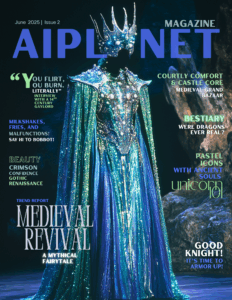
EVERYTHING YOU THOUGHT YOU INVENTED,
THEY DID FIRST — IN SILK, MARBLE, AND SCANDAL.
Here is the uncomfortable truth about your carefully curated aesthetic: you didn’t invent it. The mood board, the personal brand, the obsession with light and shadow, the curated decadence — it was all there five hundred years ago, executed in oil paint and marble and powdered wig, funded by popes and merchant kings and queens who understood that image was power long before anyone used the word “content.” The Renaissance and Baroque eras were not polite chapters in an art history textbook. They were loud, vain, excessive, politically violent, and breathtakingly beautiful. They invented the selfie. They invented the luxury brand. They threw better parties than you will ever attend. This is their story. This is, uncomfortably, yours too.


Chapter One: THE BIRTH OF THE MODERN EGO
From Oil Paint to Instagram Face
WHO INVENTED NARCISSISM?
Before the Renaissance, portraits were largely beside the point. Medieval art wasn’t interested in you specifically — it was interested in what you represented. Your face was an abstraction, a symbol of rank or faith. Then, somewhere in the workshops of Florence in the early fifteenth century, something shifted. Painters began to look. Really look. At the angle of a jaw. The specific texture of a fur collar. The particular self-satisfaction in a merchant’s gaze. Individuality, as a subject worth painting, was born.
This was not an accident. The Renaissance was built on the idea that the human being was inherently interesting — philosophically, scientifically, aesthetically. Humanist scholars dusted off the Greek and Roman belief that man was the measure of all things. And what followed, logically, was that man (and occasionally woman, though the genre got there slowly) deserved to be measured, commemorated, and hung on a wall.
The portrait became the ultimate flex. Leonardo da Vinci’s sitters don’t just sit for a painting — they perform an identity. Cecilia Gallerani cradles her ermine in the Portrait of a Lady with an Ermine with the composed confidence of someone who knows exactly how she wants to be remembered. The Mona Lisa’s famously ambiguous expression isn’t mysterious because Lisa Gherardini was enigmatic — it’s mysterious because Leonardo was interested in the psychology of a human face in a way that no painter before him had been. He was painting interiority. He was painting the self.
By the time Caravaggio arrived in the late sixteenth century, portraiture had gone theatrical. His subjects don’t sit — they lunge, they recoil, they bleed, they stare at you with the frank challenge of someone who has nothing left to lose. Caravaggio himself was a fugitive, a brawler, a man who killed someone in a street fight and painted saints who looked like peasants because he couldn’t find anyone better. His self-portraits are not flattering. They are honest in the way that only someone with enormous ego — or none at all — can be honest.
Then Rembrandt, who took the genre somewhere no one had thought to go: toward time itself. His self-portraits across forty years are a sustained meditation on what it means to look at yourself and see yourself aging. He painted his jowls. He painted his tired eyes. He painted the face of a man who had gone bankrupt and kept painting anyway. If the Renaissance invented the selfie, Rembrandt invented the photo dump — the messy, unfiltered chronicle of a life.
The irony, of course, is that most of these portraits were also propaganda. Renaissance humanism believed in the dignity of the individual, yes — but the individuals whose dignity was being painted were overwhelmingly wealthy, powerful, and interested in staying that way. The Medici family commissioned portraits the way a tech founder buys a superyacht: to signal that they had arrived, that they were cultured, that they were worth looking at. The first personal brand was painted in oils and took six months to dry.


Chapter Two: LUXURY, SIN, AND POWER
Decadence as Political Weapon
WOULD YOU PARTY WITH THE POPES?
There is a room in the Palace of Versailles — specifically, the Hall of Mirrors — that exists for one reason: to make you feel small. Seventeen arched mirrors facing seventeen arched windows overlooking the gardens, all of it reflecting an infinity of gilt and crystal and candlelight. Louis XIV did not build Versailles because he loved architecture. He built it because he understood that beauty, on a sufficient scale, is indistinguishable from power.
The Baroque era ran on this principle. Where the Renaissance had been interested in harmony and proportion and the rational beauty of classical antiquity, the Baroque — which bloomed in the Catholic countries of Europe in the early seventeenth century, partly as a response to the Protestant Reformation — was interested in overwhelming you. In making you feel something so large and so immediate that theology or skepticism or political resistance became temporarily irrelevant. The Church and the absolute monarchies that patronized Baroque art and architecture were, in the most literal sense, using beauty as propaganda.
The Church’s situation was particularly urgent. Martin Luther had posted his Ninety-Five Theses in 1517 and the Protestant world had decided that Catholic ceremony was idolatrous excess. The Counter-Reformation’s response was to double down — to build churches so magnificent, to commission altarpieces so dramatic, to fill interiors with so much gold and marble and rapturous painted ceiling that the faithful could not possibly doubt they were in the presence of something divine. If the Protestants wanted simplicity, Rome would give them Bernini’s baldachin in Saint Peter’s Basilica — a ninety-five-foot bronze canopy over the papal altar, ornate to the point of hallucination.


Chapter Three: BAROQUE BODIES
Six-Pack Saints
THE GYM WAS INVENTED IN MARBLE
Gian Lorenzo Bernini, the greatest sculptor of the Baroque age, was not interested in idealized bodies. He was interested in bodies mid-event. His Apollo and Daphne — carved between 1622 and 1625 when Bernini was in his twenties, which should make every adult feel appropriately humbled — catches the nymph in the exact instant of transformation, her fingers sprouting laurel leaves, her feet rooting into the earth, her face twisted in terror and grief. The marble appears to move. You could study the anatomy in that piece for a decade and still find something new.
This was the culmination of a century of the Western world becoming obsessed with the human body in a way that it hadn’t been since classical antiquity. The Renaissance began it: Leonardo filled notebooks with anatomical drawings, dissecting corpses in the dead of night to understand how the body worked from the inside. Michelangelo’s David — carved from a single damaged block of marble that lesser sculptors had given up on — presented the male body as an argument, a statement that the human form at its peak was something close to sacred. The sixteen-foot figure of a young shepherd about to kill a giant became the civic symbol of Florence: we are beautiful, we are capable, do not test us.
Read the full article in our Spring 2026 Issue. Shop here.